

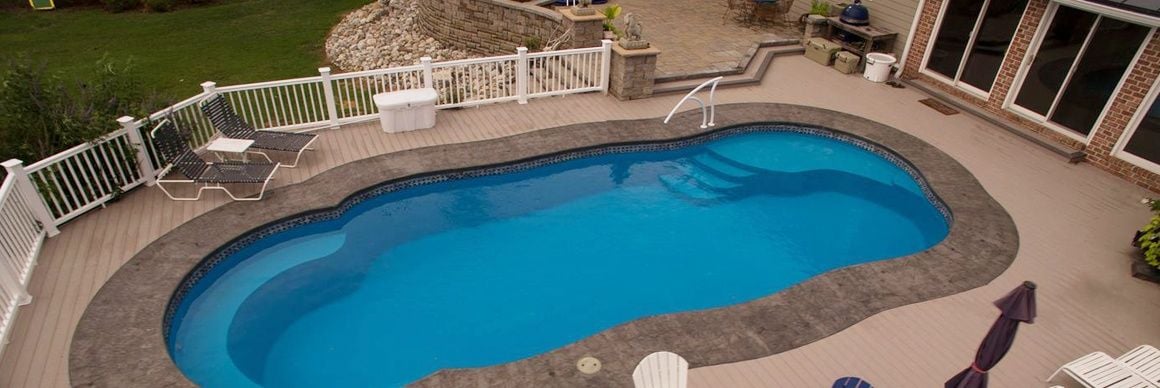
As fiberglass pools have become more common, one idea that comes up from time to time is installing them above ground.
It’s an understandable thought. If your yard has a slope, elevation changes, or other challenges, an above-ground pool can seem like the logical solution.
But here’s where things can get a little misunderstood: a true above-ground pool isn’t a fiberglass pool at all. Traditional above-ground pools are built with wall panels and supports, not a one-piece fiberglass shell.
Fiberglass pools are designed to be installed inground. In some situations, they can be adapted to sit partially above ground, but they’re not built to function as a fully above-ground pool. Manufacturers can reinforce the shell to allow a portion of it to be exposed, but this is a very different type of installation.
So while this approach can make sense in certain situations, it usually comes down to a few common reasons homeowners consider going this route.

When Does It Make Sense to Install a Fiberglass Pool Above Ground?
Here are a few of the most common situations where this idea comes up:
- They think it will be a more affordable way to install a pool.
- They’re concerned about flooding or low-lying areas in the yard.
- They want the pool to match the height of an existing deck or home.
- Their yard has a slope, and they’re trying to work with the grade.
1. Is Installing a Fiberglass Pool Above Ground Really a Cheaper Option?
Not necessarily. Installing a fiberglass pool above ground doesn’t significantly reduce the overall cost.
While you might save a bit on excavation or backfill, those savings are usually offset by the cost of a framed deck, which can be as much as, or more than, a traditional concrete patio.
It’s easy to assume that less digging means lower costs, but the difference in excavation is typically minimal.
So if the goal is to save money, going with a partially above-ground installation usually doesn’t move the needle as much as people expect.
2. Do I Need to Raise My Pool Above Ground to Avoid Flooding?
In some cases, raising the pool can help, but it’s not always required.
One common concern is that a fiberglass pool might “float” if it’s surrounded by floodwater. In reality, that’s very unlikely when the pool is properly installed. Features like a cantilevered concrete patio help anchor the pool in place and add stability.
In most situations, the bigger issue during a flood isn’t the pool moving, it’s the condition of the water afterward. Cleanup and rebalancing are usually what homeowners end up dealing with.
That said, in certain yards, especially low-lying areas, elevating the pool can be a practical solution. It really comes down to how the space handles water and what makes the most sense for the site.

3. What If I Want My Pool to Line Up with My Deck or Backyard Design?
If you have an elevated deck or patio, you may want the pool to sit higher so everything connects smoothly. This can work well, but it’s one of the more complex ways to install a fiberglass pool.
Once you start raising the pool more than about 18 inches out of the ground, it’s not just a standard install anymore. You’ll usually need some added support to make it work the right way.
In some cases, that means the pool itself may need to be custom-built or reinforced by the manufacturer, especially if it has straight walls. Pools with curves naturally handle water pressure better, so straight-wall designs often need that extra support when more of the structure is exposed.
From there, the installation may include a retaining wall around part of the pool and a deck that ties everything together and covers any exposed areas. Part of the pool is supported by the retaining wall, part of it remains exposed, and the deck helps bring the whole design together.
When it’s done right, it can come together really well, but it does require more planning and typically costs more than a traditional inground pool installation.
4. What If My Yard Slopes and I Want to Leave One Side of the Pool Exposed?
With a sloped or hillside yard, some homeowners choose to leave the downhill side of the pool exposed as part of the overall design.
This approach can work really well and is often more about taking advantage of the landscape than solving a problem.
As long as no more than about 18 inches of the pool is left above grade, this type of setup can perform just fine. The key is making sure the exposed side is properly supported and protected from erosion.
That usually means adding some form of ground cover or stabilization, things like stone, mulch, or plantings, to help keep everything in place over time.
When it’s done right, it’s a simple way to work with the natural slope of the yard instead of trying to fight it.
Should Fiberglass Pools be Installed Above Ground?
In most cases, fiberglass pools are designed for inground installation. However, certain situations may call for a partial above-ground setup. That said, it requires proper support and planning.
When the pool is installed with the right structural support, proper backfill, and a well-designed deck or retaining wall, a partially above-ground setup can come together nicely and hold up well over time.
Like anything else with a pool project, it really comes down to understanding your space and working with an experienced installer who can guide you in the right direction.

Frequently Asked Questions
Can fiberglass pools be installed above ground?
Fiberglass pools are typically designed to be installed fully inground or partially above ground. While they can be customized for more above-ground exposure, they are not meant to be installed completely above ground without proper structural support and backfill.
How much of a fiberglass pool can be above ground?
In most standard installations, up to 18 inches of the pool shell can be exposed above ground. Anything beyond that usually requires additional structural support, such as retaining walls or a custom-built pool shell.
Do above-ground fiberglass pool installations require special support?
Yes. If more than 18 inches of the pool is exposed, additional support is typically needed. This may include, reinforced or custom built pool shell, retaining walls around the pool and proper backfill and structural stabilization.
Why would someone install a fiberglass pool partially above ground?
Homeowners may choose a partial above-ground installation for several reasons, such as:
-
To match the height of an existing deck or home.
-
To manage sloped or hillside yards.
-
To address potential flooding concerns.
-
For specific design or aesthetic preferences.
From the Author
Figuring out how a pool will fit into your yard isn’t always straightforward—especially when you’re working with slopes, elevation changes, or unique layouts.
I’m Marcus Sheridan, co-founder of River Pools® Virginia, and for more than 20 years I’ve worked with homeowners navigating these types of decisions as they plan their pool projects. One thing I’ve seen time and again is that the “right” approach often depends on the details of the space and how you want the finished backyard to come together.
I wrote this article to walk through some of the most common situations where a partially above-ground fiberglass pool comes into the conversation, and what that actually involves. The goal is to give you a clearer picture of your options so you can make a decision that fits your yard and your plans.
From the Manufacturer
At River Pools, we work with homeowners across the country who are trying to figure out how a pool will fit into their backyard, especially when the space isn’t perfectly flat.
Situations like slopes, elevation changes, or raised decks often lead people to consider partially above-ground installations. Through our work with independent installers, we’ve seen how these projects can come together successfully when they’re planned the right way.
Our goal with resources like this is to give you a clear picture of your options so you can decide what makes sense for your yard.
If you’re considering a fiberglass pool, the next step is connecting with a trusted independent installer who can evaluate your space and help you determine the best approach.
Ready to start the conversation?

Topics:
