

Key Takeaways
- "Concrete cancer" describes structural deterioration in concrete caused by a chemical reaction called ASR (Alkali-Silica Reaction).
- It causes cracking, bulging, and water loss.
- ASR happens when reactive aggregate in the concrete mix reacts with alkalis in the cement in the presence of moisture, forming a gel that expands and cracks the shell from within.
- There is no permanent repair for advanced ASR. Full demolition and rebuild is the only lasting fix, and engineers working the Central Texas cases have put that cost between $150,000 and $500,000.
- Most concrete pools built with tested aggregate and a properly designed mix never develop severe ASR.
In parts of Central Texas, thousands of homeowners built their dream backyard over the past several years, only to watch it crack, bulge, and start losing water. The pool industry has a name for it: concrete cancer.
It is not a medical term, and it is not exaggerated marketing either. It is what happens when a concrete pool starts breaking down from the inside. Like the disease it borrows its name from, it usually starts small, hides beneath the surface, and can spread until it threatens the entire structure.
The scale of the Central Texas situation is what pushed this from an obscure engineering topic into a national one. The Central Texas Pool and Hot Tub Alliance now considers the Austin area a national hotspot for ASR in pools. Texas Monthly reported more than 250 confirmed cases involving pools built since 2017, while one licensed engineer working these cases estimates that as many as 30,000 pools from that period may be affected. Hundreds of lawsuits have followed, and some builders and concrete subcontractors have gone out of business.
Here is the part that usually gets lost in the coverage: this is a regional materials problem, not an indictment of concrete pools generally. Most concrete pools, built with tested aggregate and a properly designed mix, remain structurally sound for decades. The point of this article is not to scare you off concrete. It is to help you tell the difference between a pool with a real problem and a pool with a normal crack, and to know what questions to ask before you build.
What Causes Concrete Cancer in a Concrete Pool?
"Concrete cancer" is also used to describe rebar corrosion, but in the recent pool coverage it refers to ASR (Alkali-Silica Reaction), a chemical reaction that cracks and weakens the shell over time.
ASR is chemical, not mechanical, and it starts with the concrete mix itself.
Certain types of aggregate (the sand and gravel in concrete) contain reactive forms of silica. When those react with the alkali hydroxides in cement, the reaction forms a gel. That gel absorbs water and swells, creating internal pressure that cracks the concrete from the inside out. More cracks let in more moisture, which feeds more reaction. It is a cycle rather than a one-time event.
ASR specifically needs three things present at the same time: reactive aggregate, moisture, and a concrete pH of 13 or higher. Take away any single one of those, and the reaction can't proceed. Supplementary cementitious materials (SCMs) such as fly ash, slag cement, and silica fume, get added to concrete mixes in part because they cut that risk by lowering the mix's pH.
Some experts tie the Central Texas cases to a shortage of fly ash beginning around 2017.
What Does Concrete Cancer Look Like?
Concrete cancer rarely announces itself. Most owners notice something small and easy to write off long before it becomes obvious. General signs to watch for are:
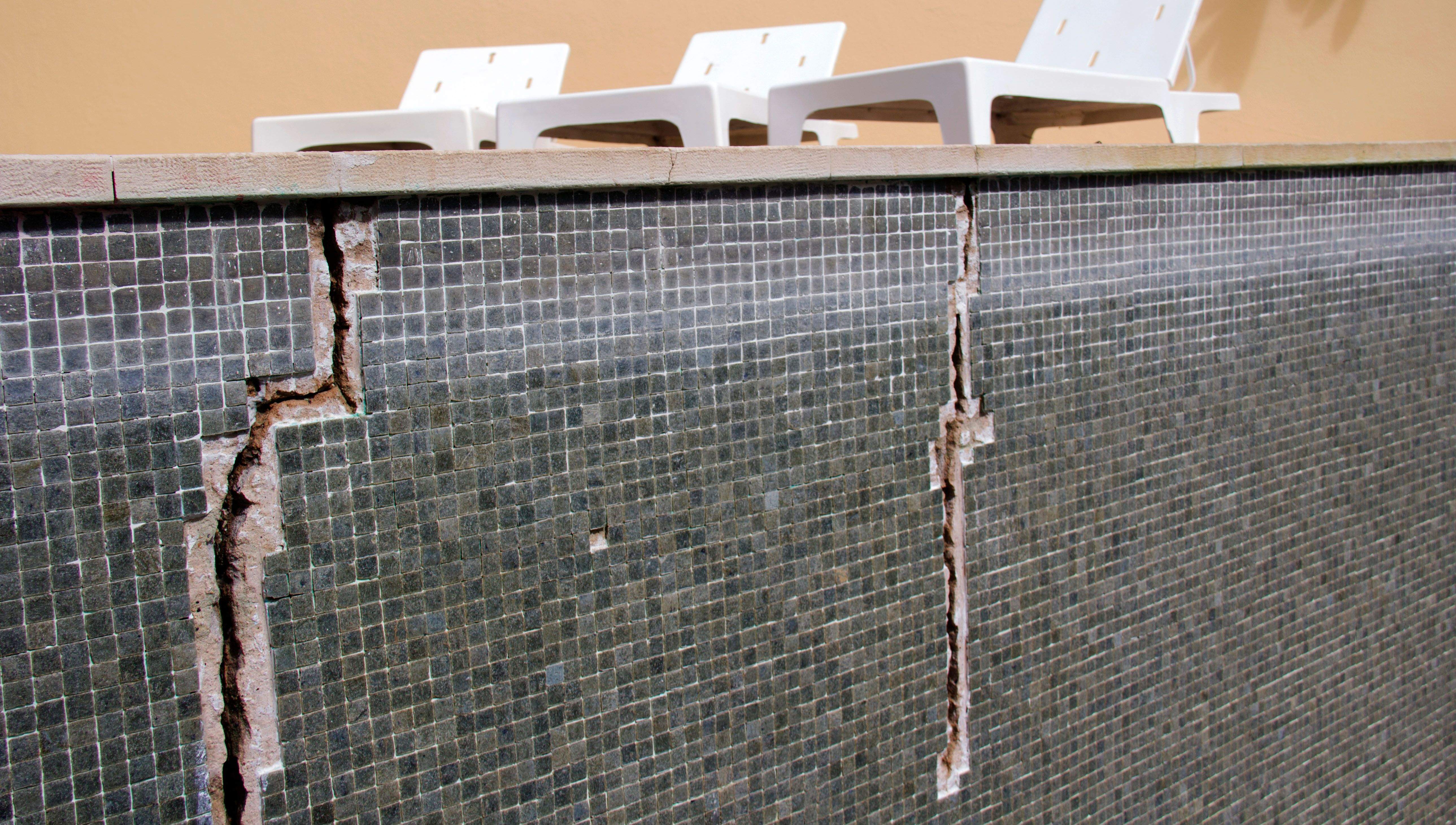
- Cracking in the walls, floor, or steps
- Bulging, warping, or uneven spots on the shell
- Tiles or coping loosening and popping off
- Unexplained water loss or new leaks
- Damage showing up first in the spa, since heat accelerates the chemical reaction
ASR presents itself as spiderweb-style cracking, often with a white or clear gel-like substance seeping from the cracks.
One important caution about white deposits. Calcium scale and efflorescence are common in every pool type and look similar to ASR gel. White residue without any cracking is almost always a water chemistry issue, not a structural one.
When to be concerned is noticing spiderweb cracking plus that gel-like substance together, not white residue alone.
It is also worth knowing the typical timeline. ASR takes a minimum of about three years to show up, so cracking in the first month is not ASR; the reaction simply has not had time to get going yet. Most affected pools show visible symptoms somewhere in the five-to-twelve-year range after that, though a few Central Texas cases moved faster, which is part of why they drew attention.
To fully identify it, a professional can come out and usually start with crack patterns and look for gel residue. If ASR seems likely, the only way to confirm it is to send a concrete core sample for lab testing, called petrographic analysis. It isn't cheap and results can take weeks, with backlogs in affected regions stretching that further.
Whether it's worth paying for comes down to how far along the pool already is. If the diagnosis is still genuinely unclear, that cost buys you a real answer before you spend on repairs. But if the cracking is already advanced and clearly headed for removal either way, some owners decide the test won't change what has to happen next, so it isn't worth paying for.

Can Concrete Cancer Be Repaired?
This issue can be a hard fix because ASR is happening inside the concrete rather than on its surface. Patching a crack can improve the look while the chemistry continues underneath. Depending on how far along it is, the options are:
- Surface patching: A cosmetic, short-term measure. Not a solution.
- Custom vinyl liner conversion: A fully custom vinyl liner fitted over the existing shell, which contains the water and hides the damage without demolition. Because it isn't bonded to the shell, it can tolerate some movement.
- Full demolition and rebuild: For advanced ASR, engineers working these cases consistently describe this as the only permanent fix.
Two things to understand about the vinyl route before you consider it. Because your pool was never designed for a liner, it will require a fully custom liner rather than an off-the-shelf one. And like any vinyl liner pool, it will need replacement roughly every ten years. It is likely still cheaper than a full rebuild, which is exactly why people consider it, but it is a bridge rather than a cure.
The hard truth is that ASR cannot be sealed away for good. A patch or a liner buys time. It does not stop the reaction.
How Much Does It Cost to Fix Concrete Cancer?
Costs vary enormously with severity and region, but as a rough guide:
- Petrographic testing to confirm ASR: roughly $4,000 to $10,000, with long waits for results.
- Custom vinyl liner conversion: less than a full rebuild, though still a significant expense, and it repeats roughly every decade
- Full demolition and rebuild for advanced ASR: engineers working the Central Texas cases have cited a range of $150,000 to $500,000, frequently double or triple what the pool originally cost to build
That gap between a repair that buys time and a six-figure rebuild is exactly why catching the problem early matters so much.
How to Prevent Concrete Cancer in a Concrete Pool
Preventing ASR comes down to controlling three things: reactive aggregate, moisture, and a concrete pH of 13 or higher. Here’s what to ask your builder about each.
1. Use tested, non-reactive aggregate.
A reliable aggregate test can take more than a year, while the faster 16-day test is much less reliable. Since aggregate sourcing and testing are typically handled by the concrete supplier, ask your builder who supplies their concrete and whether that suppliers aggregate is certified.
2. Reduce permeability in the concrete.
A pool shell is always wet, so moisture can't be eliminated. That's why aggregate and alkali control matter most. A dense mix with a low water-to-cement ratio and higher compressive strength leaves fewer voids where moisture can collect. Ask whether your builder uses dry-shot (gunite) or wet-shot concrete; dry-shot allows tighter control over added water.
3. Keep the pH below the level ASR needs.
Lithium-based admixtures are another option for inhibiting ASR. Replacing about 25% of the cement with fly ash or using low-alkali cement can help lower the mix's pH and inhibit the ASR reaction, even if some reactive aggregate is present.
It’s also worth asking whether the concrete supplier has dealt with ASR claims before, how long the builder has been working in your area, and getting their answers in writing.
If You Already Own a Concrete Pool
At this point, enjoy your pool, focus on maintenance, and learn early detection. Keep the water chemistry balanced, address cracks promptly, and avoid leaving the pool empty for extended periods without professional guidance, since groundwater and soil pressure can stress an empty shell.
A few times a year, inspect the walls, steps, and spa area for new or worsening cracks. If something looks unusual, have it evaluated sooner rather than later.

Do Fiberglass Pools Have an Equivalent Problem?
Fair question, and worth asking given who published this article.
A Fiberglass pool shell cannot get concrete cancer. There is no concrete shell, and no reactive aggregate. But that is not the same as saying fiberglass has no equivalent, and the honest answer is that it does.
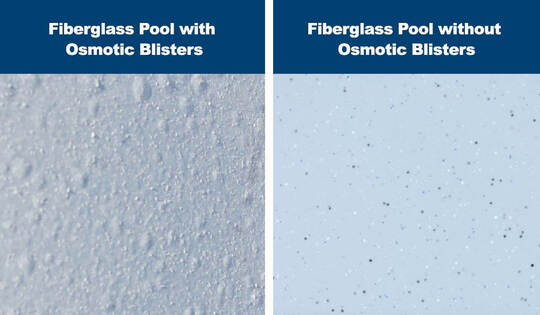
The comparable failure is osmotic blistering.
A fiberglass pool shell is built in layers, called a lamination schedule. Behind the gelcoat, the visible finished surface, there should be a layer of vinyl ester resin. That layer is the water barrier. It is what keeps water from working its way into the laminate behind the finish.
When water does get through, it forms blisters beneath the gelcoat. Enough of them, and the surface is compromised across the entire shell.
Here is what makes it the true parallel to concrete cancer: both trace back to a material decision made by the manufacturer. For fiberglass, that's the resin the shell manufacturer chooses. For concrete, it's the aggregate a concrete plant supplies.
The fiberglass industry, boats and pools alike, identified its version of this decades ago and moved to vinyl ester behind the gelcoat. Manufacturers who use vinyl ester behind the gelcoat have largely eliminated osmotic blistering.
The consequence is the same too. In severe cases, a shell riddled with osmotic blisters may need to be replaced.
The Problems That Happen to Every Kind of Pool
Most of what you hear about any pool type falls into a handful of categories, and those categories show up in concrete, fiberglass, and vinyl liner pools alike. What matters is not which material a problem happened to. It is what caused it.
Surface discoloration, staining, and scaling: Almost always water chemistry. Concrete plaster stains, etches, and scales. Gelcoat fades and whitens. Vinyl liners bleach and wrinkle. Three different surfaces, one underlying cause: water that drifted out of balance and stayed there.
Cracking: Usually installation or ground movement. Poor compaction, the wrong backfill material, a missing or undersized bond beam, inadequate drainage, or soil that shifts underneath the pool. Concrete can crack structurally, gelcoat can develop surface crazing, and vinyl liners can tear, and steps can crack.
Shell movement, bulging, or floating: Groundwater, nearly every time. A missing or non-compliant well pit, drainage that was never designed correctly, or a pool drained at the wrong moment with a high water table sitting behind it.
Leaks at fittings, returns, and plumbing: Workmanship. This one has nothing to do with what the pool is made of.
In most cases, none of these are material defects. ASR is the exception. They are execution problems, and they belong to whoever built, installed, or maintained the pool.
That distinction matters when you are shopping. A problem caused by how a pool was installed or maintained can be avoided by choosing your installer carefully and taking care of the pool. A problem baked into the raw materials cannot be avoided by anyone but the manufacturer.
Final Thoughts
"Concrete cancer" is a serious problem, and in advanced cases it can mean losing the pool entirely. If something looks wrong, get a professional diagnosis before you get a quote for anything. And if you are still in the planning stage, the questions above cost you nothing to ask. Finding out the hard way costs considerably more.
Frequently Asked Questions
What is concrete cancer?
“Concrete cancer” is used to describe rebar corrosion, but in recent pool coverage, it refers to ASR (Alkali-Silica Reaction), a chemical reaction within the concrete that causes the pool shell to crack and weaken over time.
What causes ASR in a swimming pool?
Reactive silica in the aggregate, moisture, and a concrete pH of 13 or higher must all three be present together to cause ASR in a swimming pool. Remove any one of the three, whether through tested aggregate, a dense low-moisture mix, or a lower-pH cement, and the reaction cannot proceed.
How do I know if it's ASR?
You can look for signs of ASR, such as irregular, spiderweb-like cracking and a possible gel-like exudate on the concrete surface. These symptoms usually appear within several years, though some pools have developed cracks within months. However, the only way to confirm ASR is through laboratory testing of a concrete core sample.
Can concrete cancer be fixed?
Concrete cancer can sometimes be managed with temporary solutions, but these won't stop the underlying reaction. Patching or converting the pool to a custom vinyl liner may buy time, while engineers describe a full rebuild as the only permanent fix for advanced cases.
How much does it cost to fix concrete cancer?
The cost to address concrete cancer depends on the extent of the damage and the work needed to confirm the cause and repair the pool. Petrographic testing to confirm ASR typically costs $4,000 to $10,000. For advanced cases, full demolition and rebuilding has been cited at $150,000 to $500,000, often double or triple the pool's original construction cost.
Do fiberglass pools get concrete cancer?
No, fiberglass pools cannot get concrete cancer. The closest equivalent in fiberglass is osmotic blistering, which happens when a shell is built without a vinyl ester resin barrier behind the gelcoat. Like ASR, it traces back to a raw materials decision at the factory, and in severe cases it can also end in replacement.
From the Author
Finding a crack in your concrete pool is unsettling, especially when you have no idea what you are looking at.
I am Cristian Shirilla, Marketing Manager at River Pools and co-owner of a fiberglass pool installation company in Virginia.
What I have tried to do here is give you the version I would want if this were my backyard: what the problem is, how to identify it, when to worry, when not to, and where fiberglass has an equivalent weakness of its own. For this article I reviewed engineering guidance on ASR, reviewed reports on the Central Texas cases, and interviewed a professional engineer specializing in aquatic structures.
If you have a concrete pool showing signs of trouble, your next call should be to a qualified structural or pool engineer in your area, not to a pool salesperson of any kind, including me.
From the Manufacturer
River Pools is a fiberglass pool manufacturer. We do not build concrete pools, River Pools the manufacturer does not install pools and are not in a position to perform a structural inspection.
What we can do is make sure the information is out there. Homeowners weighing concrete, fiberglass, and vinyl liner pools deserve to understand the long-term ownership realities of each one, including ours, before they sign a contract rather than after.
If you are early in that process and want to understand what a fiberglass pool would actually mean for your backyard, budget, and timeline, the next step is a conversation with an independent installer in your area. They build these pools every week, they know your local soil and permitting, and they can help you decide whether fiberglass is the right fit or not.
Ready to start the conversation?

